In short: in 2023 the WHO issued a conditional recommendation not to use non-sugar sweeteners (aspartame, sucralose, stevia and others) to control body weight1. Short trials inside weight-loss programs give a mixed picture, and in long-term observational studies sweeteners are linked to a slightly higher BMI3. That is not proof of harm: both the results and the reasons for the link remain debated.
What the WHO actually says
The recommendation covers non-sugar sweeteners added to manufactured foods and drinks or sold on their own: acesulfame K, aspartame, advantame, cyclamates, neotame, saccharin, sucralose, stevia and stevia derivatives1. It does not apply to people with pre-existing diabetes, or to sugar alcohols (polyols) and “low-calorie sugars”, which still contain calories1.
It rests on a systematic review suggesting that sweeteners give no long-term benefit for reducing body fat in adults or children, and that long-term use may have undesirable effects: a higher risk of type 2 diabetes, cardiovascular disease and death in adults1. The WHO itself rated the recommendation as conditional, because the link in the evidence might be confounded by participants’ baseline characteristics and complicated patterns of sweetener use1. The guideline also does not assess the safety of individual sweeteners and does not replace acceptable daily intake limits2.
Two kinds of evidence, two different pictures
A Canadian meta-analysis (Azad et al., CMAJ, 2017) separated the studies into two types3:
| Randomized trials | Cohort studies | |
|---|---|---|
| How many | 7 trials, 1,003 people | 30 cohorts, 405,907 people |
| Length | median 6 months | median 10 years |
| BMI result | no significant difference: −0.37 kg/m² (95% CI −1.10 to 0.36; 242 people) | small link with higher BMI: correlation 0.05 (95% CI 0.03 to 0.06) |
In the cohorts, sweeteners were also linked to higher rates of obesity, hypertension, metabolic syndrome, type 2 diabetes and cardiovascular events. For diabetes the authors noted signs of publication bias3. Their conclusion: trials do not clearly support the intended weight benefit, and observational data suggest a link with higher BMI and cardiometabolic risk3.
One caution: in cohorts people choose sweeteners themselves, and people who are already gaining weight, or worry about it, may drink “light” drinks more often. So the link does not show that the sweetener caused the weight gain. The WHO gives a similar warning: participants’ baseline characteristics may have shaped the link1.
A trial where “light” drinks helped
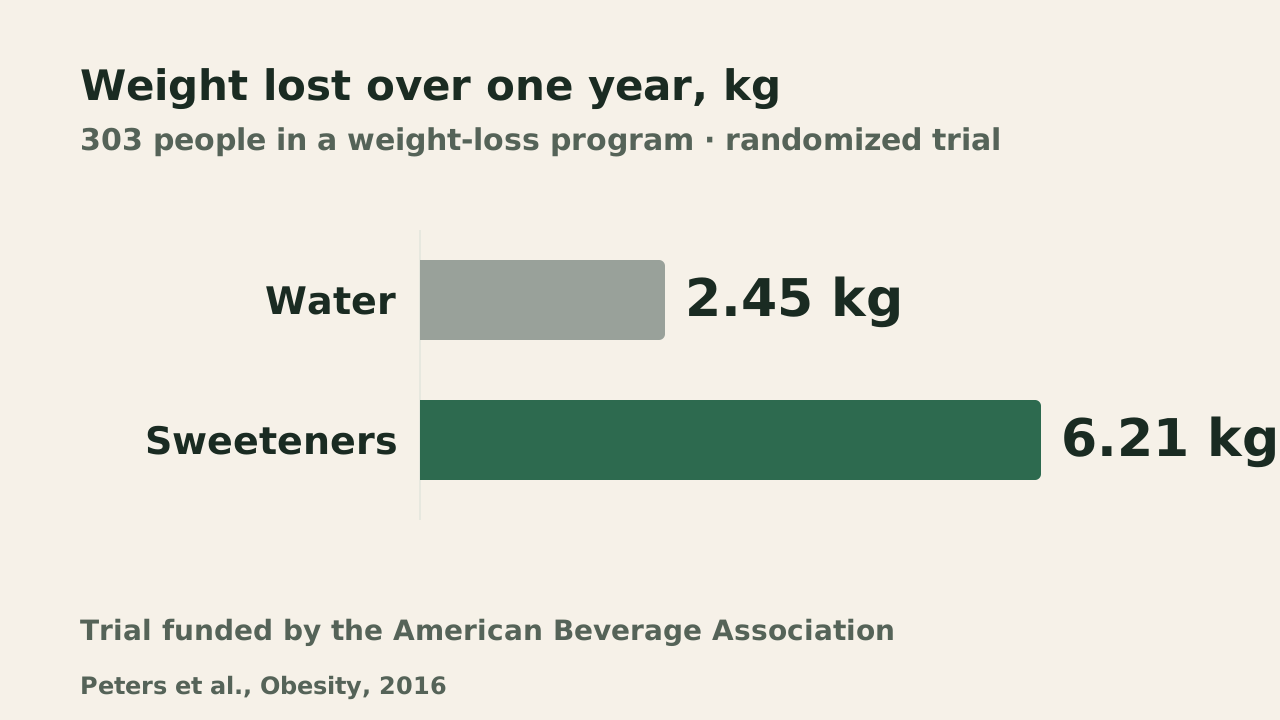
In a randomized trial by Peters et al. (Obesity, 2016), 303 people with overweight or obesity took part in a one-year behavioral weight-loss program. Some were assigned 24 ounces (710 ml) of sweetener-containing drinks a day, others water4.
- At one year the water group had kept off 2.45 kg (5.4 lb; ±5.59), the sweetened-drink group 6.21 kg (13.7 lb; ±7.65), a significant difference4;
- at 12 weeks (a separate report of the same trial): 5.95 kg (13.1 lb) in the sweetener group versus 4.09 kg (9.0 lb) in the water group; the sweetener group reported a bigger drop in hunger5.
What to know: the trial was fully funded by the American Beverage Association4. It enrolled only people who already drank sweetened beverages regularly. The water group was asked to stop them, and everyone was in a formal weight-loss program, so the result cannot be carried over to people who simply want to “drink diet cola instead of regular”4.
What you can take from this
- If you swap a sugary drink for a sugar-free one, you remove calories from the liquid (see hidden calories in drinks). The available data do not show this reliably leads to weight loss.
- The WHO suggests going further: lower the sweetness of your diet overall and choose fruit or foods without added sugar1.
- If you have diabetes, the WHO recommendation does not apply to you, and food choices are a question for your doctor1.
For sweet cravings without bans, see sugar and sweets without the binge. To estimate your daily needs, use the calorie calculator. Related: alcohol and weight and calorie deficit in plain words.
FAQ
Can I drink diet soda while losing weight?
The evidence is mixed. A trial inside a weight-loss program (industry-funded) showed a benefit, the meta-analysis of trials found no BMI difference, and the WHO does not recommend sweeteners for weight control134. If you choose them, treat them as a temporary swap, not permission for extras elsewhere.
Are sweeteners harmful?
These studies do not test safety. The WHO recommendation is not based on a toxicological assessment of individual substances2. Links with diabetes and heart disease in observational data may have other explanations1.
Does this include stevia?
Yes. Stevia and its derivatives are on the list of non-sugar sweeteners the recommendation covers1.
Does it apply to children?
The review behind the recommendation looked at both adults and children1.
Sources
- WHO: "WHO advises not to use non-sugar sweeteners for weight control in newly released guideline," 15 May 2023.
- WHO: "Use of non-sugar sweeteners: WHO guideline" (2023).
- Azad M.B. et al. Nonnutritive sweeteners and cardiometabolic health: a systematic review and meta-analysis of randomized controlled trials and prospective cohort studies. CMAJ, 2017;189(28):E929–E939.
- Peters J.C. et al. The effects of water and non-nutritive sweetened beverages on weight loss and weight maintenance: a randomized clinical trial. Obesity, 2016;24(2):297–304.
- Peters J.C. et al. The effects of water and non-nutritive sweetened beverages on weight loss during a 12-week weight loss treatment program. Obesity, 2014;22(6):1415–1421.
What readers think
Lean Wisely articles are general reading. See the disclaimer.