In short: the data reviewed here contain no supplement shown to extend the lives of adults. A review of 277 trials with nearly a million participants found mostly no effect of vitamins and antioxidants on death or cardiovascular outcomes, and the few pluses and minuses were small, with low or moderate certainty1. The popular NMN, in the one trial covered here, improved one metabolic measure in 25 women, but not their weight or physical fitness2.
What the big supplement review found
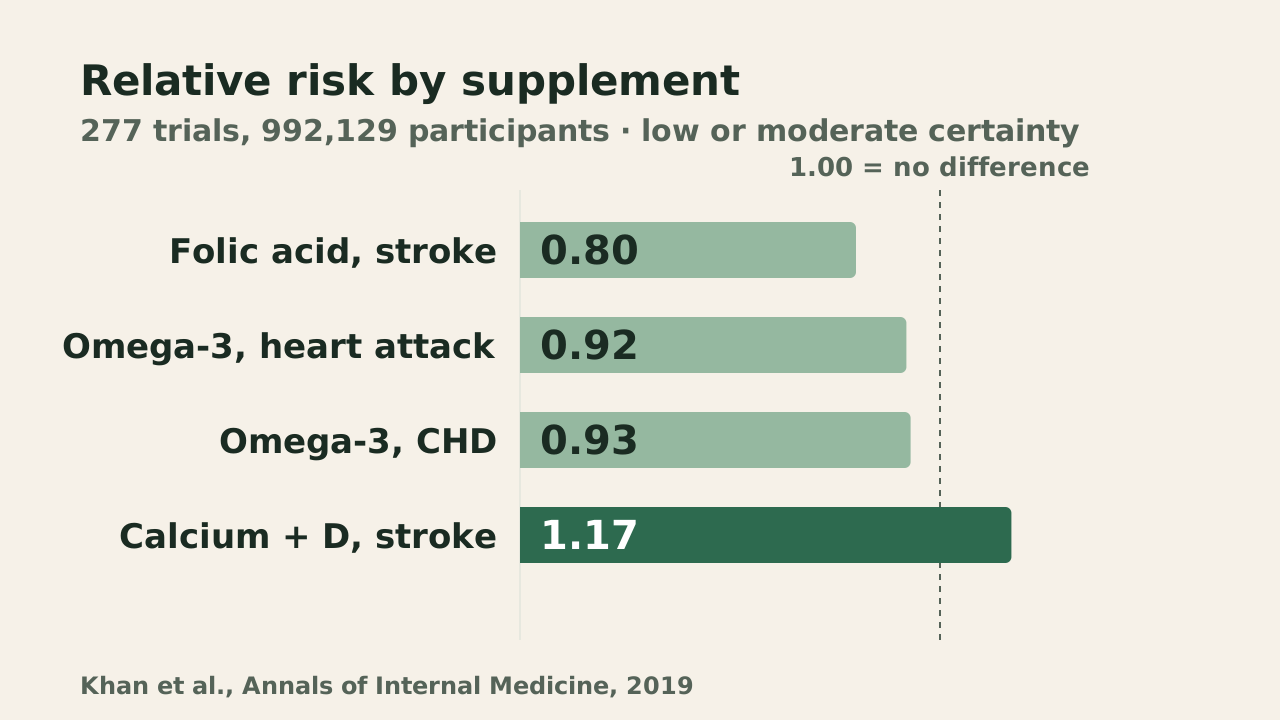
The umbrella review (Khan et al., Annals of Internal Medicine, 2019) pooled 9 systematic reviews and 4 new randomized trials: 277 trials, 24 interventions, 992,129 participants and 105 meta-analyses. It looked at death and cardiovascular outcomes, which is not “longevity” as a whole1.
| Supplement | Outcome | Relative risk (95% CI) | Certainty |
|---|---|---|---|
| Folic acid | stroke | 0.80 (0.67–0.96) | low |
| Omega-3 | heart attack | 0.92 (0.85–0.99) | low |
| Omega-3 | coronary heart disease | 0.93 (0.89–0.98) | low |
| Calcium + vitamin D | stroke | 1.17 (1.05–1.30) | moderate |
The other supplements (vitamin B6, vitamin A, multivitamins, antioxidants, iron) had no significant effect on mortality or cardiovascular outcomes; certainty ranged from very low to moderate1. The authors name the suboptimal quality and certainty of the evidence as a limitation. The review had no primary funding1.
A relative risk of 0.92 means 8% fewer events in the supplement group than in the comparison group. The abstract does not give absolute numbers, so do not read it as “8 people saved out of 100.”
NMN: what is known in people
NMN (nicotinamide mononucleotide) is a precursor of NAD+, a molecule whose biosynthesis is impaired by aging and obesity in rodents. That is where the interest in supplements comes from2.
In the trial by Yoshino et al. (Science, 2021), 25 postmenopausal women with prediabetes and overweight or obesity took 250 mg of NMN a day (13 women) or placebo (12) for 10 weeks. Muscle insulin sensitivity was 25 ± 7% higher than before in the NMN group, with no difference in the placebo group2.
But body weight and composition, blood pressure, glucose, lipids, muscle mitochondrial capacity, grip strength and muscle fatigability did not change in either group2. It is a small, short study of one group of people (we did not check its funding). It does not show that NMN extends life, slows aging or helps with weight loss.
A review by Freeberg et al. (2023) of NAD+-boosting supplements in humans concluded that they are safe and tolerable at the doses studied and raise NAD+ and related metabolites, but the evidence that this improves physiological function is unclear, and small samples limit interpretation3. A review by Migaud et al. (Nature Reviews Molecular Cell Biology, 2024) adds that NAD+ biology remains poorly understood and that fundamental research is needed to boost NAD+ safely in humans. Some of its authors disclose ties to companies in this field4.
What these data do not show
- That supplements extend life. Neither the review nor the NMN trial measured lifespan.
- That they are harmful. The results show no proven benefit, not proven harm. The exception is calcium plus vitamin D, which was linked to a higher risk of stroke in this review (moderate certainty).
- What is right for you. If you were prescribed vitamin D, iron or folic acid for a deficiency or pregnancy, that is a separate situation these data do not cover.
- Other “longevity” agents. Metformin, rapamycin and resveratrol were not reviewed here: we did not check the studies on them, so we claim nothing about them.
What to take from this
If long life is the goal, better-studied habits have a wider evidence base. Compare with the data on daily steps and longevity, strength training and sleep. Those are mostly observational too, but they at least concern things you can do for free.
Before any supplement, especially if you take medication or have a chronic condition, talk to your doctor. To check your baseline numbers, you can start with the BMI calculator.
FAQ
Should I take a multivitamin for longevity?
In the review, multivitamins had no significant effect on death or cardiovascular outcomes (certainty from very low to moderate)1. That does not mean they are harmful, but the review found no benefit for those outcomes.
Does NMN work?
It raised muscle insulin sensitivity in 25 women with prediabetes over 10 weeks but did not change weight or fitness2. There are no long-term lifespan data here.
Is NMN safe?
In a review of human studies, NAD+ supplements were safe and tolerable under the conditions studied, but samples were small3. If you are considering it, ask your doctor.
Sources
- Khan S.U. et al. Effects of nutritional supplements and dietary interventions on cardiovascular outcomes: an umbrella review and evidence map. Annals of Internal Medicine, 2019;171(3):190–198.
- Yoshino M. et al. Nicotinamide mononucleotide increases muscle insulin sensitivity in prediabetic women. Science, 2021;372(6547):1224–1229.
- Freeberg K.A. et al. Dietary supplementation with NAD+-boosting compounds in humans: current knowledge and future directions. J Gerontol A Biol Sci Med Sci, 2023;78(12):2435–2448.
- Migaud M.E., Ziegler M., Baur J.A. Regulation of and challenges in targeting NAD+ metabolism. Nat Rev Mol Cell Biol, 2024;25(10):822–840.
What readers think
Lean Wisely articles are general reading. See the disclaimer.