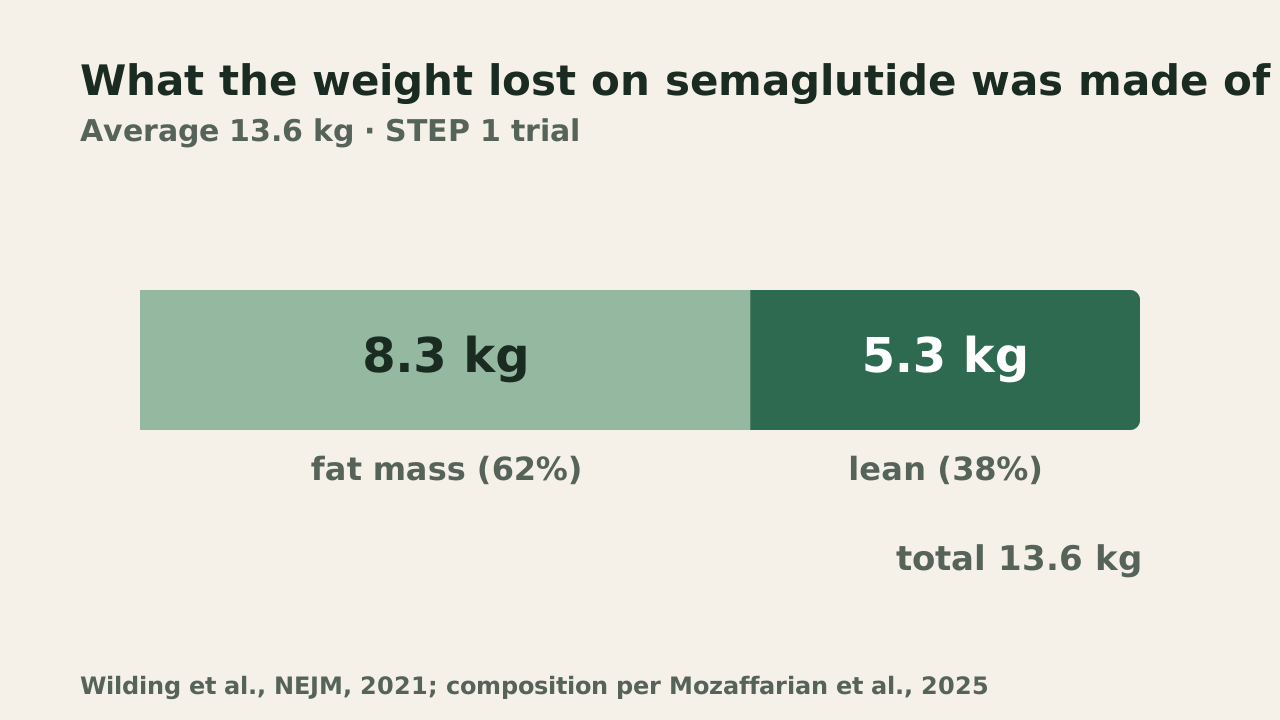
In short: on GLP-1 medicines the most common complaints are nausea and diarrhea, and some muscle is lost along with fat. In the STEP 1 trial, of 13.6 kg (30 lb) of weight lost, 8.3 kg was fat and 5.3 kg was lean mass2. A joint expert advisory from four US societies suggests small meals, enough fluids, protein, and strength training2. These are general pointers, not a prescription: your doctor decides the dose and how to eat on the medicine.
What the STEP 1 trial showed
In this double-blind trial, 1,961 adults with a body mass index of 30 or more (27 or more with a related condition), without diabetes, received semaglutide 2.4 mg weekly or placebo for 68 weeks, both alongside a lifestyle intervention1.
- body weight fell 14.9% on semaglutide and 2.4% on placebo;
- nausea and diarrhea were the most common events, usually transient and mild to moderate;
- 59 people (4.5%) on the drug and 5 (0.8%) on placebo stopped treatment because of gastrointestinal events1.
The trial was funded by Novo Nordisk, which makes the drug1.
What the advisory suggests for nausea and bowels
A joint advisory from the American College of Lifestyle Medicine, the American Society for Nutrition, the Obesity Medicine Association and The Obesity Society offers these pointers2:
- Nausea: eat breakfast, then small meals every 3–4 hours with enough fluids; in the first days it may help to avoid fatty and high-fiber foods. Vomiting is more likely after large meals.
- Constipation: enough fluids and fiber from food; a doctor may suggest other measures if needed.
- Diarrhea: avoiding large or high-fat meals can help.
- Alcohol: it can worsen nausea and reflux, so the advisory says to minimize it.
Dehydration from vomiting or diarrhea can cause acute kidney injury, so it should be prevented2. If vomiting or diarrhea does not settle, contact your doctor.
Protein and muscle
For active weight reduction the advisory gives 1.2–1.6 g of protein per kg of body weight a day, with a floor of at least 0.4–0.5 g per kg. Prolonged intake above 2 g per kg is not recommended. The authors admit there is no consensus on the figure and that actual body weight can overestimate need2. Protein alone will not protect muscle: the advisory suggests strength training at least 3 times a week and at least 150 minutes of moderate aerobic activity2.
The authors estimate that, based on STEP 1, about 20% of the weight lost is muscle (38% of the loss was lean mass, and muscle is roughly half of lean mass)2. More on training in strength training on GLP-1 medicines. Protein figures for older ages are in protein after 60.
Micronutrients
When calories drop sharply, nutrient intake can fall short, especially below 1,200 kcal a day for women and 1,800 kcal for men2. Warning signs include tiredness beyond what is expected, noticeable hair loss, muscle weakness, poor wound healing, and unusual bruising. The advisory says vitamin D, calcium and B12 can be proactively considered, tailored to the person, so any supplement is a decision for your doctor2.
What these data do not show
- An advisory, not a trial. Some recommendations rest on the authors’ clinical experience rather than comparative trials2.
- Industry ties. Many authors of the advisory report consulting ties to drug makers3.
- Real-world results are smaller. According to the advisory, outside trials weight loss at 60 weeks on semaglutide 2.4 mg was about 8% with diabetes and about 11% without2.
- Stopping is unstudied. Whether structured lifestyle therapy helps keep weight off after stopping has not been tested in controlled trials2. On weight after stopping, see what the BMJ meta-analysis found.
FAQ
What should I eat if I feel sick?
The advisory suggests small meals every 3–4 hours, enough fluids, and avoiding fatty and high-fiber foods in the first days2. If it does not pass, call your doctor.
Do I need to count calories?
You can get a reference from the calorie calculator, but with a lower appetite it matters more not to fall below the levels where the risk of nutrient shortfall rises. Discuss it with your doctor or dietitian.
Sources
- Wilding J.P.H. et al. Once-weekly semaglutide in adults with overweight or obesity (STEP 1). N Engl J Med, 2021;384(11):989–1002.
- Mozaffarian D. et al. Nutritional priorities to support GLP-1 therapy for obesity: a joint advisory. Obesity Pillars, 2025;15:100181.
- Conflict-of-interest disclosures in the same advisory (PubMed).
What readers think
Lean Wisely articles are general reading. See the disclaimer.